10 Surprising Facts About the Deep Ocean and Marine Life
Beneath the ocean waves lies an alien world filled with underwater mountain ranges, centuries-old sharks, and creatures with three hearts. Most of what we think we know about the deep sea only scratches the surface of what’s actually down there.
Let’s clear up ten common myths and dive into the astonishing reality of our oceans and marine life.
1. The world’s longest mountain range is under the ocean.
What do people usually think?
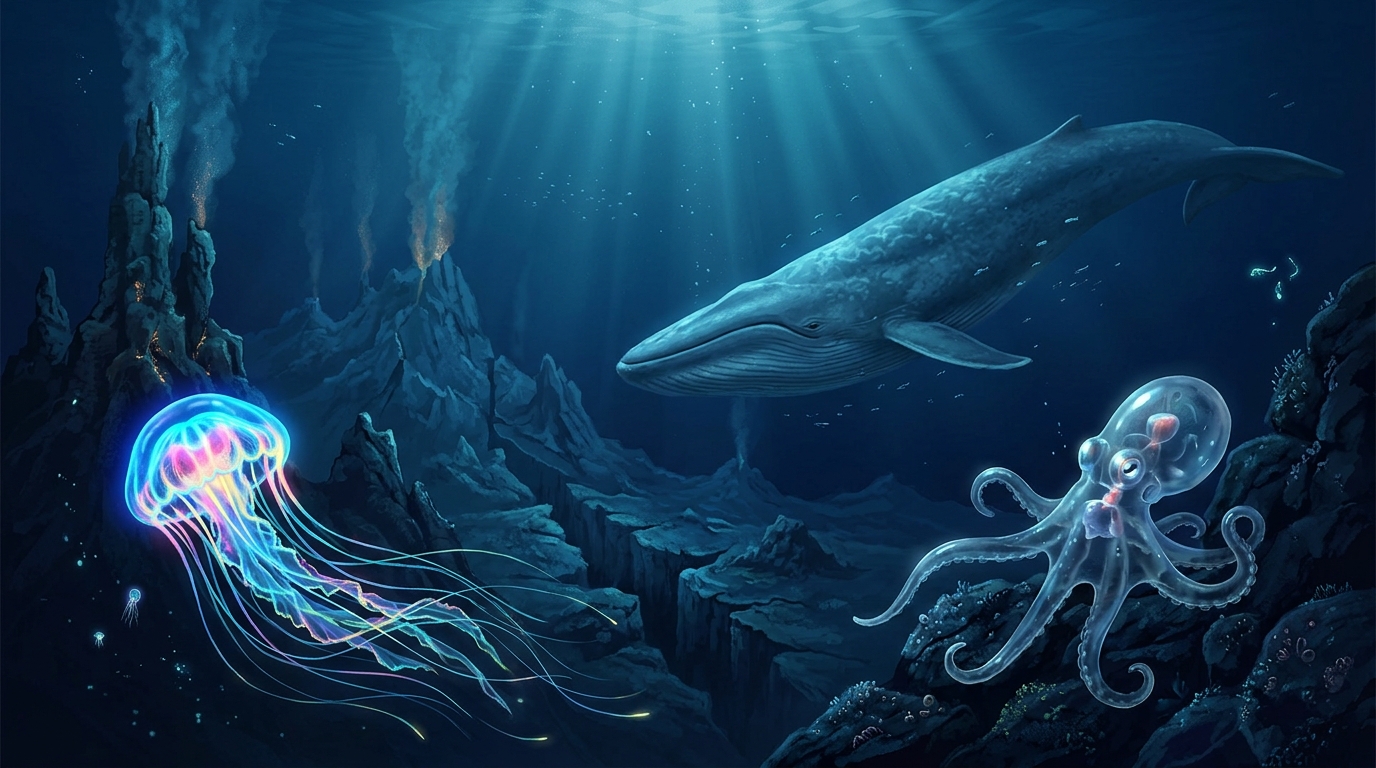
People think that the world’s longest mountain range is found on land. When mountain ranges are mentioned, we usually imagine the famous Himalayas, which are the most prominent and visible, especially to hikers and climbers. You won't believe this, but the longest mountain is in the depths of the ocean.
Here is the astonishing reality:
According to the
World Atlas, the Mid-Ocean Ridge is the world’s longest mountain range. This mountain has a total length of 65,000 km, with
90 percent of its system lying beneath the ocean.
This massive underwater system was formed through the movement of tectonic plates, where seafloor spreading created a continuous chain of ridges far longer than any range found on land.2. We can detect Earth’s tectonic plates moving.
What do people usually think?
Many of us think that the rumbling sound we hear during an earthquake is caused by friction from tectonic plates. We imagine the plates grinding against one another loudly beneath the Earth’s surface. It's hard to believe, but the sound we hear is not coming from tectonic plates.
Here is the astonishing reality:
Indeed, this slow drift is responsible for shaping continents, creating mountain ranges, and opening new ocean basins over
millions of years.
3. The ocean is the world’s largest museum.
What do people usually think?
Some of us take this expression literally and imagine the ocean as an organized museum filled with displays and artifacts. Others may not realize it is a figure of speech and assume it only refers to shipwrecks hidden underwater! What if I told you it is not only the shipwrecks that make the oceans the world's largest museum?
Here is the astonishing reality:
This is a famous line from
Salomon Reinach in 1928, where he implied that under all these forms of water, there have been countless and undiscovered cultural treasures that must be protected.
Archaeologists estimate there are more than 15,000 archaeological sites off the Atlantic coast alone, including ancient shipwrecks and sunken cities.Beyond these, the ocean also contains
natural "collections” and unique ecosystems like a true museum.
It preserves both human heritage and natural history, which constantly reminds us of the importance of conservation.4. Most deep-sea animals make their own light.
What do people usually think?
Contrary to what we usually see in mainstream media, the majority of ocean life cannot produce its own light. Like pictures of glowing fish and jellyfish, it is easy to assume that this is common to all ocean animals. It’s not what you think because most ocean life makes its own light.
Here is the astonishing reality:
According to the
Smithsonian Ocean, only about 76% of deep-sea animals are capable of
bioluminescence—living organisms using chemical reactions in their bodies to create light.
This ability is mostly found in fish, squid, and some jellyfish. According to Monterey Bay Aquarium Research Institute,
97–99% of jellyfish and siphonophores are bioluminescent, while only about half of squids and fish glow.
Although glowing creatures are fascinating, they represent only a portion of the ocean’s biodiversity, not the majority.5. The ocean floor has hydrothermal vents
What do people usually think?
Many of us would think that the deep ocean floor is just empty, dark, and lifeless. Or others would say that every hydrothermal vent means there’s an active volcano directly under it. But it turns out the ocean floor contains hydrothermal vents.
Here is the astonishing reality:
According to the
National History Museum, the ocean floor contains hydrothermal vents, which are like underwater hot springs.
These vents form when seawater enters cracks in the seafloor, gets heated by hot rocks or magma deep below, and then shoots back out carrying minerals.While vents are connected to volcanic heat, they don’t always mean there’s an
active volcano right under them.
What’s more incredible is that these vents support unique ecosystems with creatures that can survive without sunlight by using chemicals from the vents instead.6. The largest animal on Earth is found in the ocean.
What do people usually think?
People believe that the biggest animal on Earth is the whale shark because its name includes "whale." Meanwhile, some believe that the biggest animal is not in the ocean but on land, specifically the dinosaur, because they are depicted as large in movies and illustrations.
Here is the astonishing reality:
This is larger than the
whale shark, which weighs around 20.6 tons.
The blue whale is also larger than dinosaurs, specifically Argentinosaurus, which weighed 65-80 tons.7. Some sharks have lived for centuries.
What do people usually think? People usually think that since sharks are classified as fish, they can only live shorter than we all know.
Well, that sounds interesting! But what if some fish could live over 200 years? Would you believe?
Here is the astonishing reality:
Yes, most fish have an
average lifespan of 20 years, such as goldfish.
However, according to the National Oceanic and Atmospheric Administration or NOAA, the Greenland Shark is a type of shark that can live for centuries.It can live for over 250 to 500 years because it has a slow metabolism and can adapt to cold and deep water.
This slow metabolism can result in gradual aging and stagnant movement, which helps them to live longer.8. The jellyfish can live forever
What do people usually think?
Many of us think that there are no living creatures that can live forever like immortals, such as the jellyfish. They often imagine how that creature can live forever, when they see jellyfish on seashores dying.
This will blow your mind because jellyfish can live indefinitely.
Here is the astonishing reality:
The
immortal jellyfish (Turritopsis dohrnii) can live forever because it can reverse age and regrow its cells.
According to BBC Earth, this immortal jellyfish may die physically, but its cells can reaggregate, allowing it to reverse its age and regrow its cells.However, this jellyfish is still capable of dying, especially since its size is only 3–4.5 millimeters; they are vulnerable to being eaten by predators, such as fish, sea turtles, slugs, and other creatures. Biologically, it can live forever, but it can't escape the harm posed by other sea creatures, which gives it the possibility of dying.
9. There's a glass octopus.
What do people usually think?
We often perceive the glass octopus as completely invisible and hard to spot in the oceans. You won't believe this, but the organs of this creature is visible to our eyes.
Here is the astonishing reality:
The body of the glass octopus (Vitreledonella richardi) is
transparent; however, its organs can be seen through its translucent body.
Even though it is transparent, the optic nerve, eye, and digestive tract are visible.Aside from that, the glass octopus can still
change color, and the yellow specks from its webbing, or chromatophores, help it blend with its surroundings.
10. There is a creature with three hearts and blue blood
What do people usually think?
People used to think it was impossible for living things to have blue blood and three hearts. This is because they were taught in school that the heart is only one and the color of blood is red.
But this will blow your mind because there is a creature that exists with three hearts and blue blood.
Here is the astonishing reality:
As per
National Geographic, an octopus has three hearts and blue blood. Its
blue blood contains copper, rather than iron, which gives its blood a blue color.
Moreover, its three hearts have different roles: one circulates blood around the body, and two are responsible for pumping it to the gills to pick up oxygen.Conclusion
From the massive Mid-Ocean Ridge hidden on the seafloor to translucent glass octopuses and immortal jellyfish, the ocean never runs out of ways to surprise us. Every new discovery proves that Earth’s waters hold far more mystery and wonder than any sci-fi movie. Exploring these facts reminds us just how incredible—and worth protecting—our marine ecosystems really are.
If you enjoyed this or have another topic you want us to explore next, drop a comment below!
Comments (0)
No comments yet. Be the first to comment!