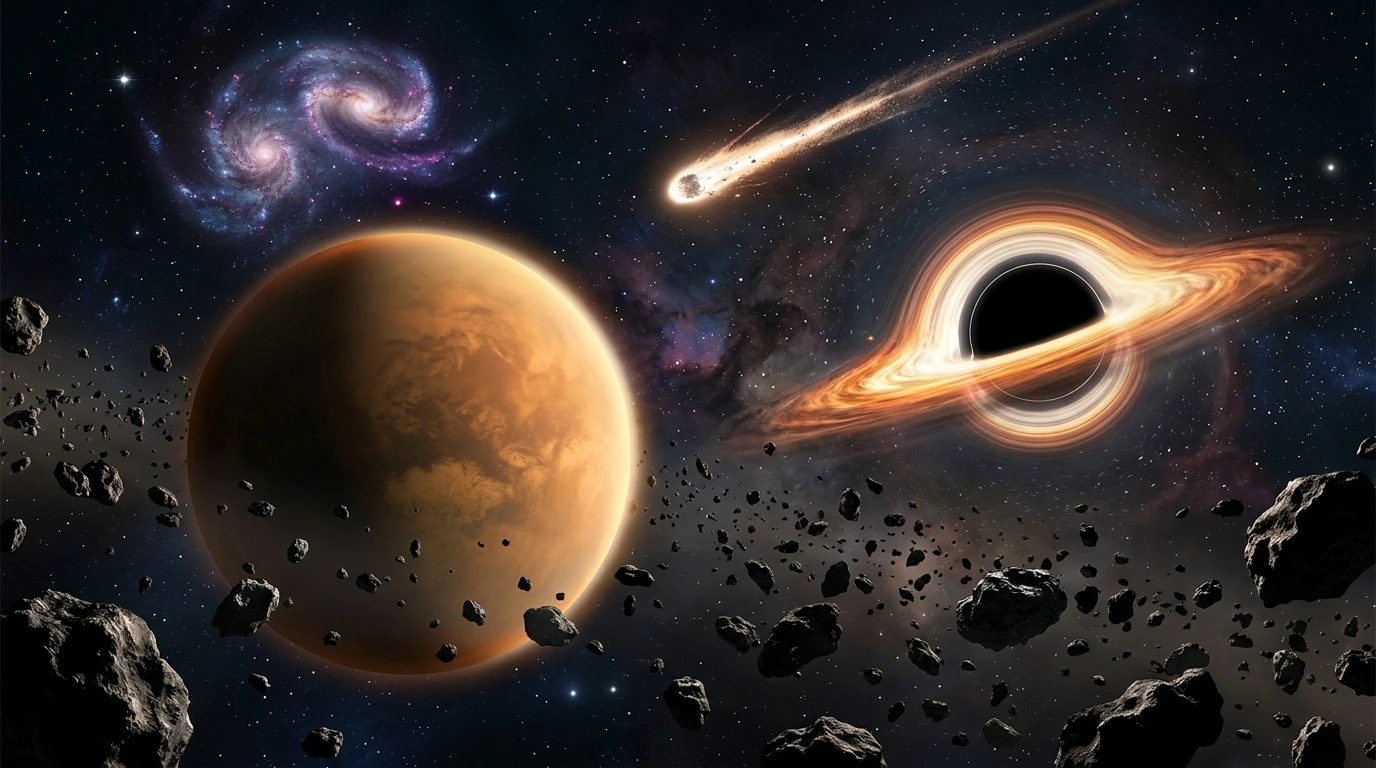
Beyond What Meets the Eye
When we look up at the night sky, it’s easy to assume we already have a pretty good picture of how space works. But out beyond our atmosphere, the universe plays by a completely different set of rules that often defy common sense.
From black holes that spin near the speed of light to moons larger than actual planets, here are some fascinating space truths that might surprise you.
1. Meteors are tiny, but they burn bright due to friction in Earth’s atmosphere.
What do people usually think?
Many people believe that shooting stars are those actual stars that have fallen from the sky—an occurrence that we wish upon. But, what if these shining lights are not stars?
Here is the astonishing reality:
Meteors are not stars at all. These are tiny fragments of rocks that drift through space, hit our atmosphere, and which we once thought were shooting stars. When these rocks enter the Earth’s atmosphere, friction with the air generates intense heat, causing them to glow brightly.
However, when these fragments of rock are in space, they are called meteoroids, but when they land on Earth, these pieces are known as meteorites.
2. Some Martian meteorites have landed on Earth.
What do people usually think?
People usually think that all meteorites that have landed on Earth are just random fragments of rocks in space. What if I told you that some meteorites came from Mars?
Here is the astonishing reality:
The small fragments of rocks, also known as Meteorites, are not just random rocks. According to NASA Science, most fragments of rocks found on Earth were from splintered asteroids, while some of these tiny rocks are from Mars or the Moon.
For instance, the Martian meteorite was formed when fragments from the planet Mars were blasted off its surface due to its powerful impact. Since Mars’s composition includes weaker gravity and a thinner atmosphere, it is easier for the rocks to shatter into space.
3. No meteorites from Mercury have ever been confirmed on Earth.
What do people usually think?
We often conclude that if some meteorites come from Mars and the Moon, then Mercury, too. But that kind of logic doesn't work in this case.
Here is the astonishing reality:
Scientists confirmed that no meteorites have been found to have originated on Mercury. Its location and strong gravity make it harder for rocks to break and reach the Earth’s atmosphere.
Candidates like Northwest Africa 15915 and Ksar Ghilane 022, the two well-known meteorites, are still examined to clarify claims about their connection to Mercury.
4. The asteroid belt isn’t crowded — objects are spaced very far apart.
What do people usually think?
The asteroid belt is a famous demarcation separating the rocky planets from the gas giants. Movies portray it as a region between Mars’ and Jupiter’s orbits, filled with millions of colliding debris. A scary and chaotic place. This is how we envisioned the asteroid belt. But what if I told you that we are wrong?
Here is the astonishing reality:
The asteroid belt lies between 2.1 and 3.3 AU from the sun. It is home to millions of irregularly shaped space rocks, called asteroids. But despite the sheer number of asteroids within the region, the asteroid belt is mostly space. It is because asteroids are relatively small. One asteroid can be as small as 10 meters across. One of the largest known asteroids is Vesta, which measures 530 km in diameter.
What’s even crazier is the fact that if you fly your spaceship through the asteroid belt, the odds of you encountering an asteroid are only one in one billion!
5. Some black holes can spin at nearly the speed of light.
What do people usually think?
Some people believe that black holes move at the speed of light and will suck everything in. However, not everything is as it seems because black holes do not travel through space at nearly the speed of light.
Here is the astonishing reality:
Some black holes have top speeds because of their high angular momentum. According to the National Aeronautics and Space Administration (NASA), the black hole GRS 1915+105 is considered the fastest one, with over 1,000 rotations per second. In fact, its spin is close to the speed of light.
For comparison, a helicopter blade makes about five spins in a single second. This black hole, however, rotates at approximately 1,000 rotations per second.
6. Black holes don’t “suck” like vacuums — they have extreme gravity.
What do people usually think?
Many believe that black holes are holes where objects cannot escape. They imagine that any cosmic objects that pass them get swallowed entirely inside, trapped for eternity. What you're about to know will change everything, as black holes don't suck like vacuums.
Here is the astonishing reality:
Black holes are not holes but are spherical cosmic objects filled with dense concentrations of matter that are tightly packed within a small space. Nearby matter or light can be pulled by its extreme gravitational force.
However, most black holes are not actively consuming anything at all but silently occupy a small amount of space in the universe.
7. Black holes will stretch you to infinity.
What do people usually think?
Most people think that matter gets trapped in a black hole, falling into a sinkhole. Some think that you get sucked in whole, like in a vacuum, when you pass by it. People even believe that you get sent to another dimension through these black holes. The truth is far stranger than you can imagine, because black holes are not vacuums sucking everything in.
Here is the astonishing reality:
In reality, black holes do not act like vacuums or shortcuts to the other sides of space. However, as cosmic objects draw close to the black hole, they are pulled apart or “spaghettified” by intense gravitational pull to the point of no return, known as the event horizon. This phenomenon is known as spaghettification or noodle effect.
This occurs when matter is stretched by immense gravity, spun around, compacted, extremely heated, and ultimately pulled inside the black hole.
8. Jupiter’s moon is bigger than Mercury.
What do people usually think?
People usually imagine that planets are always larger than moons, especially when considering the size of the Moon compared to our planet, Earth. You won't believe this, but not all planets seem bigger than the moon.
Here is the astonishing reality:
Not all planets are indeed larger than moons. Jupiter's moon, Ganymede, is bigger than Mercury. This planet not only holds the title of being the biggest planet, but also has the largest moon.
According to data from the National Aeronautics and Space Administration (NASA), Ganymede (Jupiter's moon) has a radius of 1,635 miles (2,631 kilometers) and a diameter of about 5,270 km (3,275 miles). Meanwhile, Mercury has a radius of 1,516 miles (2,440 kilometers) and a diameter of about 3,030 miles (4,878 km).
Ever heard of that before?
9. Titan has a thick atmosphere, denser than Earth’s.
What do people usually think?
Most of us perceive the moon and other planets within our solar system as uninhabitable, desolate worlds with no atmosphere, like Titan in Saturn. An atmosphere on a moon on such a scale as Titan is tenuous to most people. Conditions like methane lakes and rivers on a moon are also not considered by most people. Did you know, contrary to our common belief, some planets have thick atmospheres?
Here is the astonishing reality:
The colossal satellite of the planet Saturn, called Titan, has a thick atmosphere consisting largely of nitrogen, denser than that of Earth. Dense atmosphere results in an unusual orange haze covering the surface, making it difficult to see. Titan also has lakes and rivers of methane, which form a condition found nowhere else.
NASA observes that Titan is covered in nitrogen and methane gas, which makes the surface of the moon extremely cold, and possibly habitable to organic chemistry. Hence, scientists consider Titan as one of the potential living habitats.
10. Galaxies can collide and merge into larger galaxies.
What do people usually think?
When the topic of a galactic collision comes up, they tend to think of it like two planets that are solid hitting one another. They visualize two spheres, which resemble Earth, hitting like a car crash and making a massive impact.
Here is the astonishing reality:
Instead of a "car crash" type of collision, galaxies collide in a way that is not solid. Rather, the gas clouds in galaxies are compressed, which leads to the birth of new stars. Sometimes, if two galaxies can’t go through each other, they combine into one giant galaxy. The new galaxy looks different from the two that joined.
Additionally, according to research presented by the Associated Press, there’s a 50% chance that the Milky Way itself is on course to collide with the Andromeda Galaxy in about 10 billion years.
Conclusion
Space has a funny way of reminding us how much mystery still exists beyond what we can see with the naked eye. Every new discovery shows that the universe is far more dynamic and surprising than it first appears.If you enjoyed reading these facts—or if there’s another space topic you’re curious to learn more about—drop a comment below and share your thoughts.
Comments (0)
No comments yet. Be the first to comment!