10 Fascinating Facts About Our Solar System and Black Holes Explained
Between our own cosmic neighborhood and the deepest corners of space, the universe is full of surprises that don't always match what we learned in school. From the giant protective bubble wrapping our solar system to black holes that act like cosmic time machines, reality turns out to be way more fascinating than science fiction.
Let’s break down ten common space myths and see what’s actually happening out there.
1. Our solar system is inside a giant bubble.
What do people usually think?
Most people intuitively think that our solar system is placed in a vast, empty void—a location in space where it is completely open and exposed. Because of this, we are terrified that heavenly bodies may hit and harm our Earth.
However, did you know that our solar system is not completely open but is inside a giant bubble?
Here is the astonishing reality:
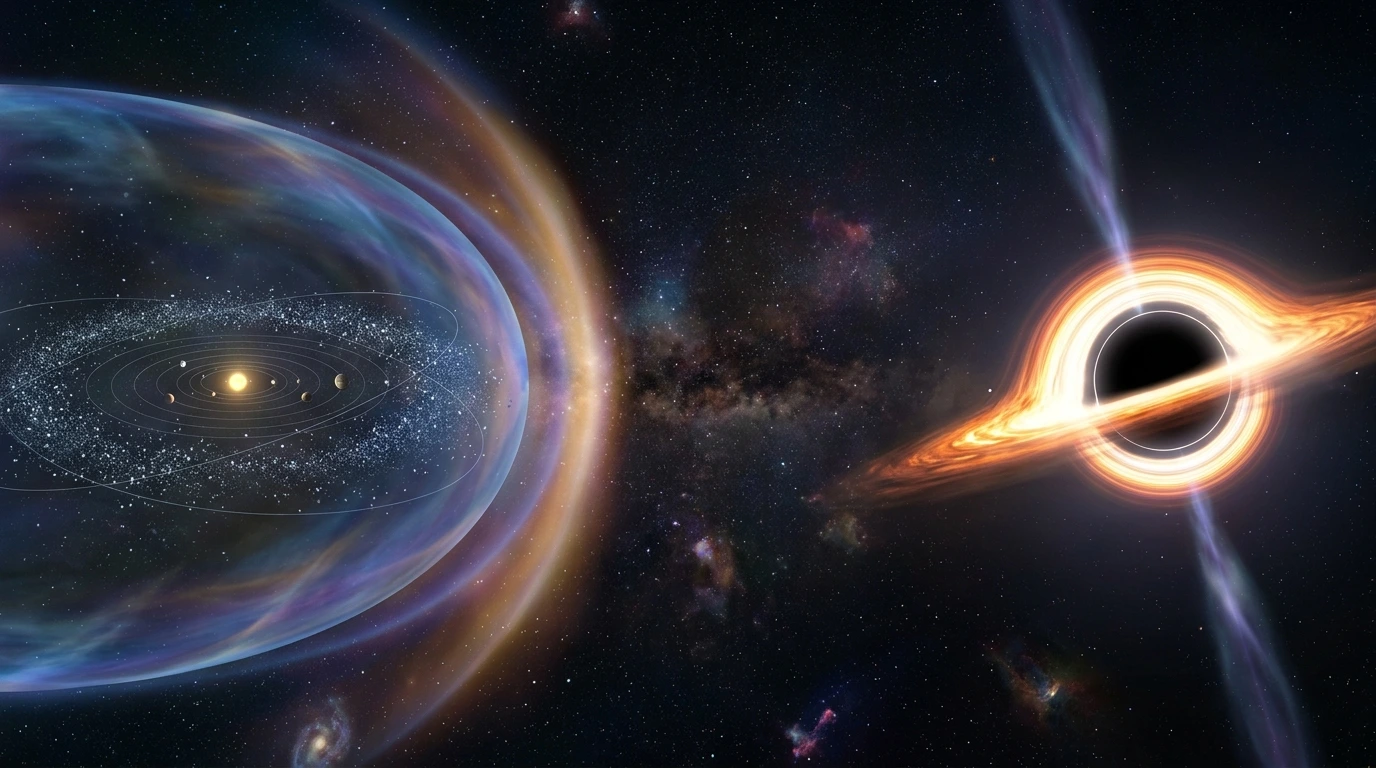
Our solar system is not just open to the universe; instead, it is encapsulated in a giant bubble called the heliosphere, a vast bubble-like region in space.
The
heliosphere is created when the sun emits solar wind continuously in all directions.
As a result, a giant bubble is created, acting as our shield and invisible barrier against cosmic rays.There are times when, during
low solar activity, galactic particles penetrate the bubble.
However, these particles can't affect our daily lives, because even if they penetrate the heliosphere, our Earth has its magnetic field and atmosphere that serve as our extended shield against galactic particles2. Our solar system also revolves around the center of the Milky Way
What do people usually think?
As taught in school, many of us learned that the Earth revolves around the sun. That is why we often imagine that only our Earth orbits the sun in the solar system.
But what if I told you that the solar system in which our Earth revolves around the sun is also orbiting the center of the Milky Way? This sounds like an orbit within an orbit?
Here is the astonishing reality:
Meanwhile, our solar system only requires
230 million years to complete one revolution.
Isn't it an awe-inspiring fact that while the Earth is orbiting, our solar system is also revolving around the center of the galaxy?3. The Kuiper Belt is full of icy objects beyond Neptune
What do people usually think?
People often think that the Kuiper Belt and the Asteroid Belt are similar. They think the Kuiper Belt as a region that is filled with dwarf planets and other rocky objects.
But that’s not quite right — the Kuiper Belt is even more fascinating.
Here is the astonishing reality:
The Kuiper Belt is a donut-shaped disc that extends from
4.5 billion to 7 billion kilometers away from the sun.
It occupies the area beyond the orbit of Neptune towards the borders of our solar system. So, what’s so special about the Kuiper Belt?
It is home to millions of icy celestial bodies known as Kuiper Belt Objects, or KBOs.
4. The Oort Cloud may stretch halfway to the next star system
What do people usually think?
Those unfamiliar with the Oort Cloud and the Kuiper Belt think they refer to the same thing. Both are thought to be vast regions at the solar system's edge, containing icy objects and planetesimals.
That’s why it is very easy to confuse one with the other. But the Oort Cloud is in a league of its own.
Here is the astonishing reality:
The Oort cloud refers to the hypothetical region that surrounds the solar system. Think of it as a sphere as opposed to the disc-shaped Kuiper Belt.
It was named after Dutch astronomer Jan Oort, who proposed its existence in 1950. It spans roughly 2,000 to 100,000 AU from the sun.5. The solar system lies in the outer disk region of the Milky Way in the Orion Arm.
What do people usually think?
Many people believe that the solar system is at the center of the Milky Way. You won't believe it, but our solar system lies in the outer disk of the Milky Way.
Here is the astonishing reality:
Based on calculations by the National Aeronautics and Space Administration (NASA), our solar system is roughly
26,000 light-years away from Sagittarius A*.
Meaning, we are actually at the quieter outskirts of our galaxy’s gravitational influence, called the Orion-Cygnus Arm.Our nearest stellar neighbors, like Alpha Centauri and Sirius, are also located in this same region of the Orion Arm. Now that’s a relief; we are not at the center of our galaxy.
6. Black holes can grow by feeding on stars.
What do people usually think?
The black hole is often imagined as a “monster” of space, envisioned as a giant vacuum that roams around the universe. People also believe that it swallows or sucks any star or planet that crosses its path.
You won't believe this, but black holes do not actually swallow the space objects around them.
Here is the astonishing reality:
In reality, black holes are not
cosmic vacuum cleaners, but they can grow larger by swallowing stars or even planets that are too close to them.
When an object is near the black hole, it is stretched apart by the extreme tidal forces due to the black hole’s intense density and gravity.This process is known as spaghettification, a term popularized by Stephen Hawking in his book “A Brief History of Time.” It describes how matter was pulled into thin strands before being consumed—stretched like spaghetti, he illustrated.
7. Black holes can throw matter back into space.
What do people usually think?
People imagine that an object near a black hole is swallowed and has no chance of escaping its strong pull. Others believe that a black hole can only pull matter inward and never eject any object back into space.
But did you know that some matter can escape the black hole?
Here is the astonishing reality:
Some of the gas and plasma in the
accretion disk (not inside the black hole) will be expelled into space as a jet that moves at nearly the speed of light.
Jets are created due to extreme magnetic fields around the black hole that accelerate matter outward.8. The largest known black hole is 40 billion times the mass of the Sun.
What do people usually think?
People often think that all black holes look the same, usually imagined as small, star-sized objects. They also believe that supermassive black holes in galaxies only reach a few million solar masses, without realizing they can grow much larger.
Surprisingly, black holes have their own identities, making each one unique.
Here is the astonishing reality:
Contrary to popular belief, black holes can grow beyond their normal sizes.
The largest black hole is located in the galaxy Holm 15A, measuring 40 billion times the sun’s mass.9. Mini black holes might exist inside our galaxy.
What do people usually think?
People speculated that if a black hole existed near Earth, it could be so massive and destructive that it might swallow our planet. Tiny black holes are often compared to dangerous “space bullets” that could tear Earth apart at any moment.
However, these mini black holes could either cause harm or pass through our planet harmlessly.
Here is the astonishing reality:
Small black holes, known as
primordial black holes, are believed to have formed in the very early universe.
They can be smaller than an atom, with gravitational effects strong enough to trap tiny amounts of matter, like atoms and molecules.According to
sciencenews.org, a primordial black hole that has the same mass as an asteroid could pass through Earth without causing major damage, even though it might slightly alter the
orbits of satellites in detectable ways.
10. Black holes can act like cosmic time machines.
What do people usually think?
Time machines are a popular concept in the science community, imagining black holes as objects to travel freely in the past or future. Some people even believe that by entering or passing near a black hole, you could travel to different times or locations in the universe.
But what if I told you that a black hole is just a piece of the time machine puzzle?
Here is the astonishing reality:
Despite being a widely discussed concept, the
gravitational forces near black holes would destroy any matter that attempts to pass through, making practical time travel impossible.
In theoretical physics, this idea remains purely speculative and unproven.Conclusion
From the hidden edges of our own solar system to the extreme physics of black holes, space never runs out of ways to surprise us. What sounds like pure science fiction—like cosmic bubbles, spaghettification, and mini black holes—is actually grounded in real astronomy. Exploring these facts reminds us just how dynamic and mysterious our universe really is.
If you enjoyed this or have another space topic you want us to explore next, drop a comment below!
Comments (0)
No comments yet. Be the first to comment!