10 Mind-Blowing Ocean Facts That Debunk Common Myths
The ocean covers over 70% of our planet, yet most of what lies beneath the surface remains a complete mystery to us. From hidden underwater waterfalls that dwarf anything on land to the surprising reason seawater is actually blue, reality is way stranger than we assume.
Let’s dive into ten common ocean myths and uncover what’s really happening in the deep.
1. Most of Earth's species live on land, not in the ocean.
What do people usually think?
Our Earth is covered by 71% water, and we often imagine that most creatures or life here on Earth are found in oceans.
But what if I told you, contrary to the common belief that 94% of life is found in oceans, this is a misconception?The astonishing reality:
The Earth we live on consists approximately of 71% water and 29% landmass.
And believe it or not, more than 80% of the ocean's subsurface is still undiscovered. It is no wonder that many people think there are more living creatures in the oceans than on land.That is approximately 74.71% of the total Earth's species! Hence, referring to the notion that 94% of living species are aquatic is misleading.
2. More than 80% of the ocean has never been explored.
What do people usually think?
People often imagine that, since we are in the modern world with advanced technology, they roughly think that no surface on Earth is still hidden. It seems the Earth's surface is already naked!
You won't believe this, but more than 80% of the ocean underneath is still untamed.
The astonishing reality:
Despite all the advancements of modern technology, the ocean's surface still holds mysteries.
This sounds hilarious because scientists can map outer space, such as the Moon and Mars, but not our oceans, right?
3. The Pacific Ocean is larger than all of Earth's landmasses combined.
What do people usually think?
Some people often imagine that when all landmasses are combined, the overall area is greater than the Pacific Ocean.
And the craziest part is, even if all of Earth's landmasses were combined, it wouldn't be enough to fill the size of the Pacific Ocean!
The astonishing reality:
And you know what? The Pacific Ocean alone covers 45% of the ocean surface, or 64,000,000 square miles.
See? Even if all the continents around the globe are calculated as a whole, the Pacific Ocean's surface area is still larger than all the lands and islands on Earth.
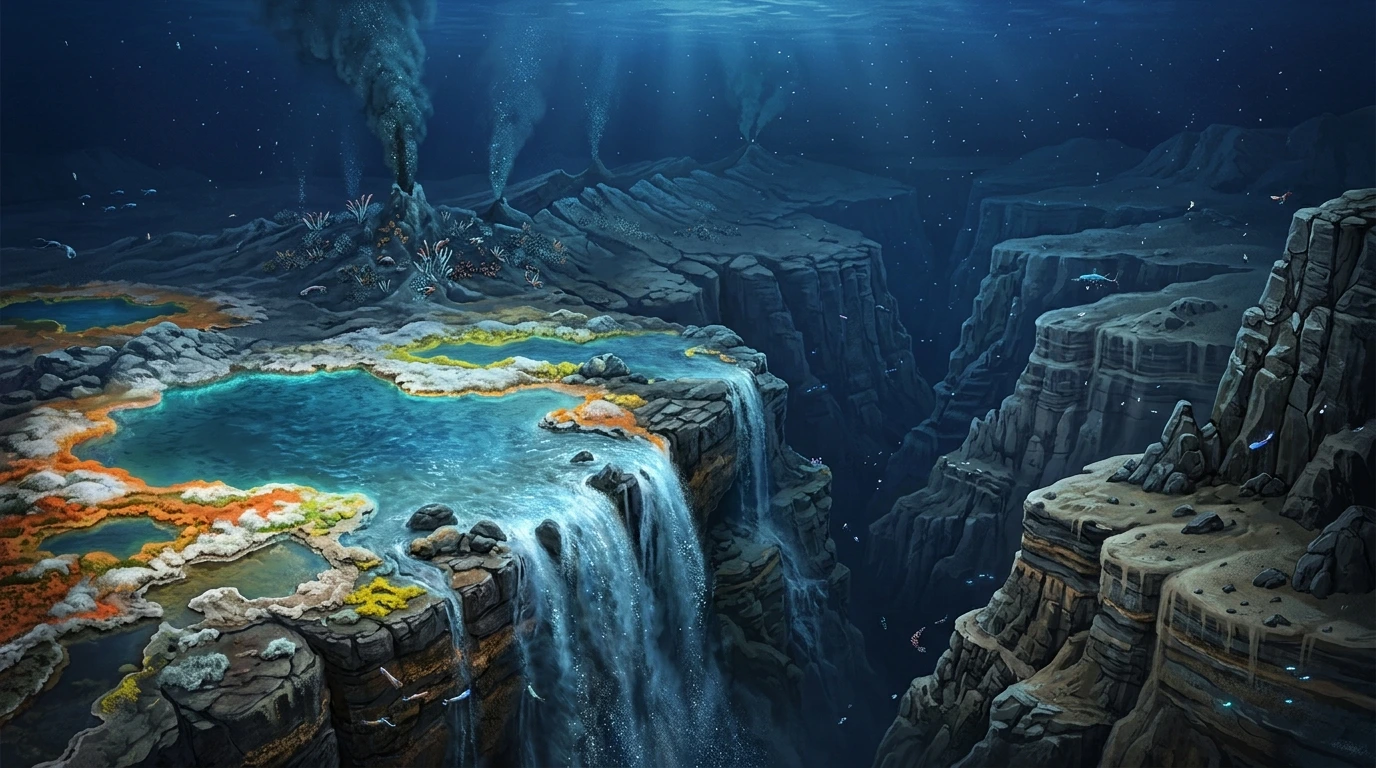
4. There are underwater lakes and rivers in the ocean.
What do people usually think?
People think that lakes and rivers are only associated with land that flows into the ocean. You won't believe this, but the ocean itself, like land, has lakes and rivers!
The astonishing reality:
71% of the Earth's surface is covered by water, and 97% of this water is in the ocean.
In this enormous surface of water, there are so-called "brine pools," especially on the sea floor of the ocean.These brine pools are known as
hypersaline water or super salty water, where this water is extremely dense and heavier than other seawater.
Because of this, these brine pools create a distinct layer that looks like "lakes" and "rivers" that flow into the ocean.Isn't it a mind-blowing fact that the ocean itself has lakes and rivers, like land?
5. The ocean's color comes from itself, not just a reflection of the blue sky.
What do people usually think?
Many people believe that the blue color of the ocean is just a reflection of the sky.
What if I revealed to you that the blue color you see in the ocean is a result of how light interacts with water?
The astonishing reality:
When sunlight hits water, the molecules react and either absorb or scatter the different wavelengths of light. Colors that have the longest wavelengths, such as red, orange, and yellow, are absorbed by water molecules. This is the main reason why, as light goes deeper, these colors eventually disappear.
While colors with the shortest wavelengths, such as blue, indigo, and violet, are scattered in all directions in the ocean, this makes our ocean
naturally blue.
Therefore, it is not the reflection of the blue sky that makes our ocean blue; rather, it is an interaction between water molecules and the wavelengths of light.
6. The largest waterfall on Earth is in the ocean.
What do people usually think?
People imagine that when they hear the word ‘waterfalls’ or ‘the largest waterfall,’ they would think of visible land waterfalls like Victoria Falls (the largest by combined width and height) or Angel Falls.
However, they don’t realize that waterfalls can also be located underwater.
Here is the astonishing reality:
One of the largest waterfalls on Earth is the Denmark Strait Cataract.
It is not a usual waterfall that is between high mountains; rather, it is in the depths of the oceans. This waterfall is located between Greenland and Iceland.From here, you can find a cold, dense water flow beneath warmer water, creating an underwater waterfall nearly
11,500 feet (3,505 meters) tall, far exceeding the height of any land waterfall.
This waterfall remains invisible to the eye and is detected only through high-end or advanced oceanographic measurements.7. The ocean is becoming more acidic.
What do people usually think?
Many people usually think that the ocean is stable and that its acidity does not change significantly over time. Others may presume that the change in our atmosphere does not affect them. However, little did we know that the ocean is constantly changing.
Here is the astonishing reality:
Our ocean becomes more acidic due to increased absorption of carbon dioxide (CO₂). This carbon dioxide from the atmosphere reacts with seawater to form carbonic acid. When seawater reacts with carbonic acid, it releases hydrogen ions.
These hydrogen ions cause acidity and alter the ocean's pH balance, threatening marine ecosystems.
8. The ocean is much saltier than you think.
What do people usually think?
People often think that the taste of table salt is the same as that of the ocean. However, ocean water is saltier than we think.
Here is the astonishing reality:
As
ScienceDirect explains, the ocean contains approximately
3.5% salt, which means there are 35 grams of dissolved salts per 1000 mL of seawater.
And if this salt in the saline waters were spread evenly over the Earth’s land surface, it would form a layer about the height of a 40-story office building.According to the
National Ocean Service, the salt in the oceans primarily comes from land runoff, hydrothermal fluids and vents, underwater volcanic eruptions, and domes.
9. There are massive canyons under the sea.
What do people usually think?
When you ask some people about canyons, most of us would think of well-known ones, like the Grand Canyon in Arizona, the top trekking spot Colca Canyon, or Europe's most beautiful canyon, Verdon Gorge, in France.
But there are some even bigger than these land canyons, and sea animals live inside them like underwater valleys.
Here is the astonishing reality:
Massive underwater canyons exist beneath the ocean's surface, formed by a combination of sediment flows, tectonic activity, and ancient river erosion when sea levels were lower.
These submarine canyons, some larger and deeper than terrestrial canyons, provide habitats for
diverse marine species and influence underwater currents.
10. More than 80% of all volcanic activity happens in the ocean.
What do people usually think?
People imagine volcanoes as mountains on land that erupt lava. They can be seen easily and have erupting features above the Earth's surface. However, most volcanic activities often happen under the ocean.
Here is the astonishing reality:
National Geographic Education states that submarine volcanoes are volcanoes that are hidden beneath the sea and found along mid-ocean ridges where plates pull apart.
These volcanic eruptions and activities under the ocean make new seafloor.
Conclusions
With over 80% of the ocean still unexplored, the deep sea holds far more surprises than we could ever imagine. From massive underwater canyons to brine pools that act like sunken lakes, Earth’s oceans are practically an alien world right here on our own planet. Learning these facts reminds us just how vast, mysterious, and vital our oceans really are.
If you enjoyed this or have another topic you want us to dive into next, drop a comment below!
Comments (0)
No comments yet. Be the first to comment!