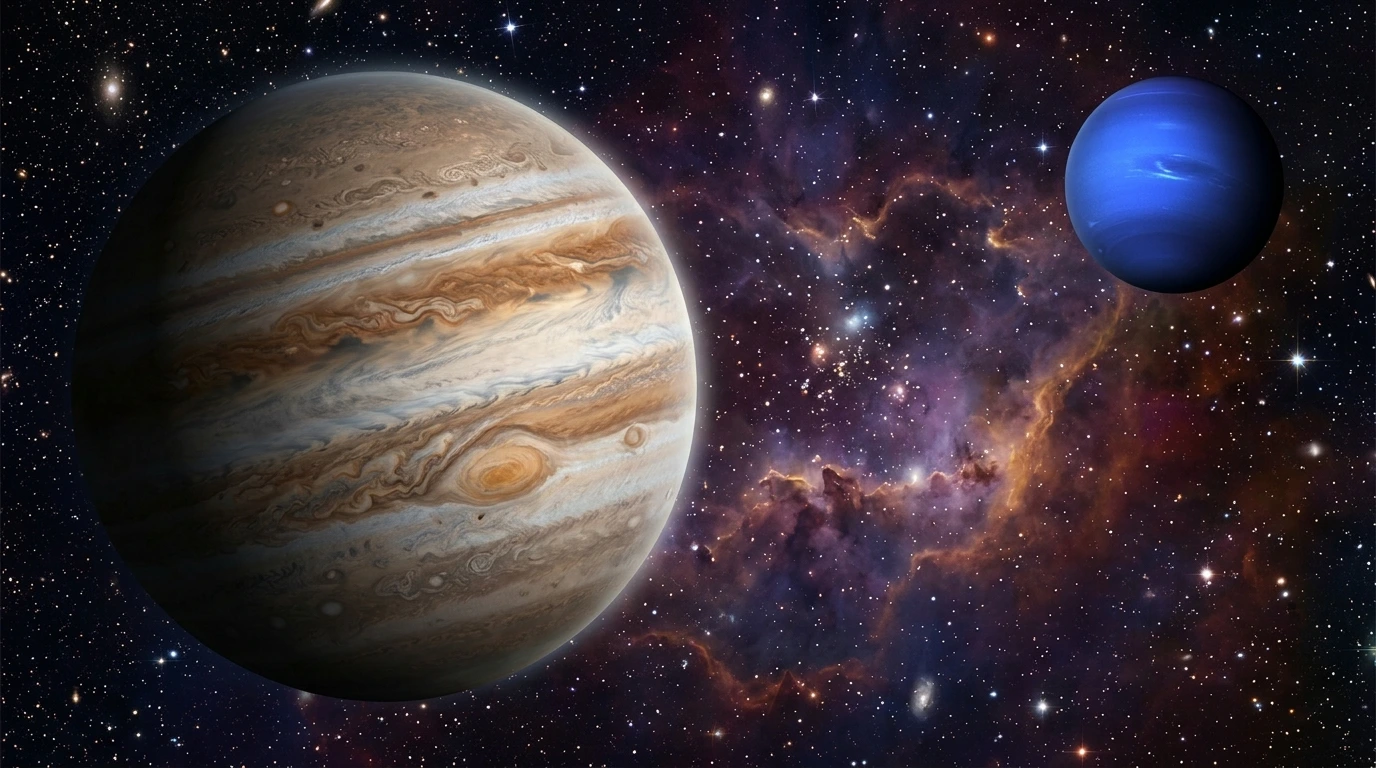
What we think we know about space vs. what’s actually out there
When we look up at the night sky, it’s easy to think we have a pretty good handle on how space works based on what we know here on Earth. But the truth is, the universe loves to defy our everyday expectations with extreme weather, mind-bending timelines, and hidden forces we can’t even see. Here are ten surprising facts that prove space is far stranger—and more fascinating—than most of us imagine.1. Jupiter’s Great Red Spot is a giant storm larger than Earth.
What do people usually think?
At a glance, it seems like the reddish-orange swirling thing inside Jupiter is just a permanent dent, almost like a spot on a rock that doesn’t do anything. Rather, individuals often overlook the fact that it is significantly more complex than merely a crater-like characteristic.
Here is the astonishing reality:
The size of this so-called ‘spot’ is an anticyclonic storm on Jupiter that is way larger than our planet.
As NASA found, its ancient storm was so large that it could fit a total of three Earths inside it. Yes, it’s a giant and active storm system, even if it doesn’t seem like it from afar.
According to new findings from the Hubble Space Telescope, this giant storm crater has been shrinking over the past hundred years. And it’s getting smaller today. Currently, it measures around 10,250 miles in diameter, which is less than fifty percent of certain past measurements. From Jupiter’s colossal storms, let’s move to a planet that spins in a way that defies expectations.
2. A day on Jupiter lasts only 10 hours.
What do people usually think?
Comparing the size of Jupiter to Earth, it is more massive, right?
So people often assume that since it’s larger, it must take a longer time to complete a rotation and therefore spin much slower. However, size doesn’t always matter, and Jupiter is here to prove that.
Here is the astonishing reality:
In contrast to our planet, which rotates at a slower 23 hours, 56 minutes, and 4 seconds, Jupiter rotates the fastest, completing a day in just 9 hours and 50 minutes. This is the fastest of any planet in the solar system, and a remarkable speed given Jupiter’s size. The reason it rotates so quickly is its mass and angular momentum. As a result, it has the shortest days of all the planets in the solar system.
3. Jupiter has at least 95 confirmed moons.
What do people usually think?
Most of us often imagine that all planets around the solar system have only one moon, like Earth. But what if I told you Jupiter has almost 100 moons?
Here is the astonishing reality:
The National Aeronautics and Space Administration reports that Jupiter has 95 confirmed moons recognized by the International Astronomical Union. Scientists believe that the reason behind Jupiter having many moons is due to leftover materials (gas and dust) in the circumplanetary disk around young Jupiter (big moons) and from captured debris pulled by Jupiter's strong gravity (small, irregular moons).
4. Neptune has the fastest winds in the solar system.
What do people usually think?
Being famous for its intense storms, people often assume that Jupiter has the fastest winds in the solar system. After all, the biggest planet should have the wildest weather. But the scientific truth is far from that observation.
Here is the astonishing reality:
Jupiter’s wind speed is way too low compared to Neptune, where the fiercest storms in the solar system occur, featuring winds that can reach speeds of 2,100 km/h. The atmosphere there is so intense that it drives frozen methane clouds around at over 1,200 miles per hour. For comparison, even the most destructive hurricanes on Earth peak at about 253 mph (407 km/h), which was observed during Tropical Cyclone Olivia in 1996.
Even Earth's most destructive storms are tiny compared to Neptune’s, where survival would be impossible. Yet, from the fastest winds to the fastest rotation, Jupiter once again surprises us.
5. A year on Neptune lasts 165 Earth years.
What do people usually think?
A common misconception is that one year on Earth is equivalent to one year on Neptune. It’s like saying that Neptune takes the same time as Earth to complete one revolution around the sun. But that is far from the truth.
Here is the astonishing reality:
Neptune takes about 164.79 Earth years to revolve on its orbit around the sun. That is equivalent to 60,190 Earth days! But why does it take that long for Neptune to finish one revolution? The primary reason is that Neptune’s planetary orbit is approximately 30 astronomical units, or 4.5 billion kilometers, away from the sun. That is why, even though the planet has an average of 5.43 km/sec orbital speed, it still takes 165 years to complete one whole Neptunian year.
6. There’s way more water in space than on Earth.
What do people usually think?
People have an intuitive perception that, since our planet is known as the "Blue Planet" and 71% of the Earth's surface is covered by water, there are no heavenly bodies that have as much water as the Earth. But you won't believe this, because in reality, there is more water in space than on Earth.
Here is the astonishing truth:
Despite being known as the "Blue Planet," our planet Earth is not the only heavenly body that contains a large amount of water.
In fact, according to the National Aeronautics and Space Administration (NASA), there are water molecules in space that were formed when two atoms of hydrogen (from the Big Bang) and one of oxygen (processed in the cores of stars) were combined.
As an example, in the Orion Nebula (an enormous cloud of dust and gas), many water molecules exist and form even to this day.
And you know what? Based on NASA, this nebula is largely composed of hydrogen gas and creates over 60 times the amount of water to fill the Earth's oceans.
7. The coldest spot in the universe is not in deep space but in a lab.
What do people usually think?
We often think that nature can offer much more than humans, especially when discussing extreme conditions. However, you will not believe that humans were able to create the coldest spot in a lab.
Here is the astonishing reality:
Logically, the coldest place in the universe should be in deep space. However, when discussing extreme conditions, whether natural or not, the coldest temperature is not in deep space but in a lab.
As stated by the National Aeronautics and Space Administration (NASA), the Boomerang Nebula is the coolest place in the universe, with a temperature of 1 Kelvin. That is approximately -460 degrees Fahrenheit.
But, the coolest temperature that humans have ever achieved in a lab is 38 picoKelvin (or 0.000000000038 Kelvin). That is −459.67 degrees Fahrenheit. Hence, the Boomerang Nebula is the coolest natural place in the universe, while the man-made coldest spot was created in a lab.
8. Space is not as silent as you think.
What do people usually think?
People usually believe that most of the space is essentially a vacuum, so they think that there is no channel or medium for sound waves to travel and produce sounds.
But did you know that, contrary to the common belief, space is not completely silent?
Here is the astonishing reality:
Sound needs a medium, such as a gas, a solid, or a liquid, to transfer energy. However, it is impossible to transmit sounds when we are in a vacuum. While it's true that most of space is nearly a perfect vacuum, there are celestial bodies, such as nebulae and galaxy clusters, that have enough gas to allow sound waves to propagate.
One example of these celestial bodies is a galaxy cluster, which is roughly composed of hundreds or thousands of galaxies. This collection of galaxies contains stars, gas, and dust and is bound by its gravity. And since these galaxies have enough gas, sound transmission is possible.
Therefore, even if most of the space is a vacuum, as discussed, it is not entirely silent.
9. The observable universe may contain more stars than all the grains of sand on Earth.
What do people usually think?
People usually think there are more grains of sand on Earth than stars in the universe. Our perception of the universe is so limited that people cannot fully understand just how wide the universe is. Some people will only believe what they see; hence, they might think the readily observable sand on Earth must be more than the distant stars in the universe.
What you’re about to discover will blow your mind, as there are many more stars in the universe than the grains of sand.
Here is the astonishing reality:
Using the most up-to-date geological studies, scientists predicted that there are 7.5 sextillion grains of sand on Earth, while astronomers estimated that there are a minimum of 70 septillion stars.
It is also important to note that the universe is expanding at an increasing rate over time, with the majority of space remaining unobserved. Hence, there are more stars in the universe than there are grains of sand on Earth.
5. Most of the universe is invisible.
What do people usually think?
Because of what we see in the media about space being full of stars and planets, we tend to think that’s all the universe really is. Guess what?
Less than 5% of the entire universe is made up of matter we can actually see, like stars, planets, and galaxies.
Here is the astonishing reality:
The entire universe is divided into three components: normal matter, dark matter, and dark energy. The stars, planets, and other celestial bodies we see in space make up only about 5% of the entire universe.
According to the National Aeronautics and Space Administration (NASA), approximately 27% of the universe is made up of dark matter, while around 68% consists of dark energy. Hence, what we see in the media about space represents only about 5% of the entire universe.
This means that most of the universe is actually invisible.
Conclusion
At the end of the day, the universe has a funny way of reminding us how little we actually know compared to what’s still waiting to be discovered. From massive storms and supersonic winds to hidden matter we can’t even see, space constantly challenges our everyday logic. It’s wild to think that every time we look up at the night sky, we’re only catching a tiny glimpse of the full picture.If you enjoyed these facts or have a specific space mystery you’re curious about, drop a comment below—we’d love to know what you want us to explore next!
Comments (0)
No comments yet. Be the first to comment!