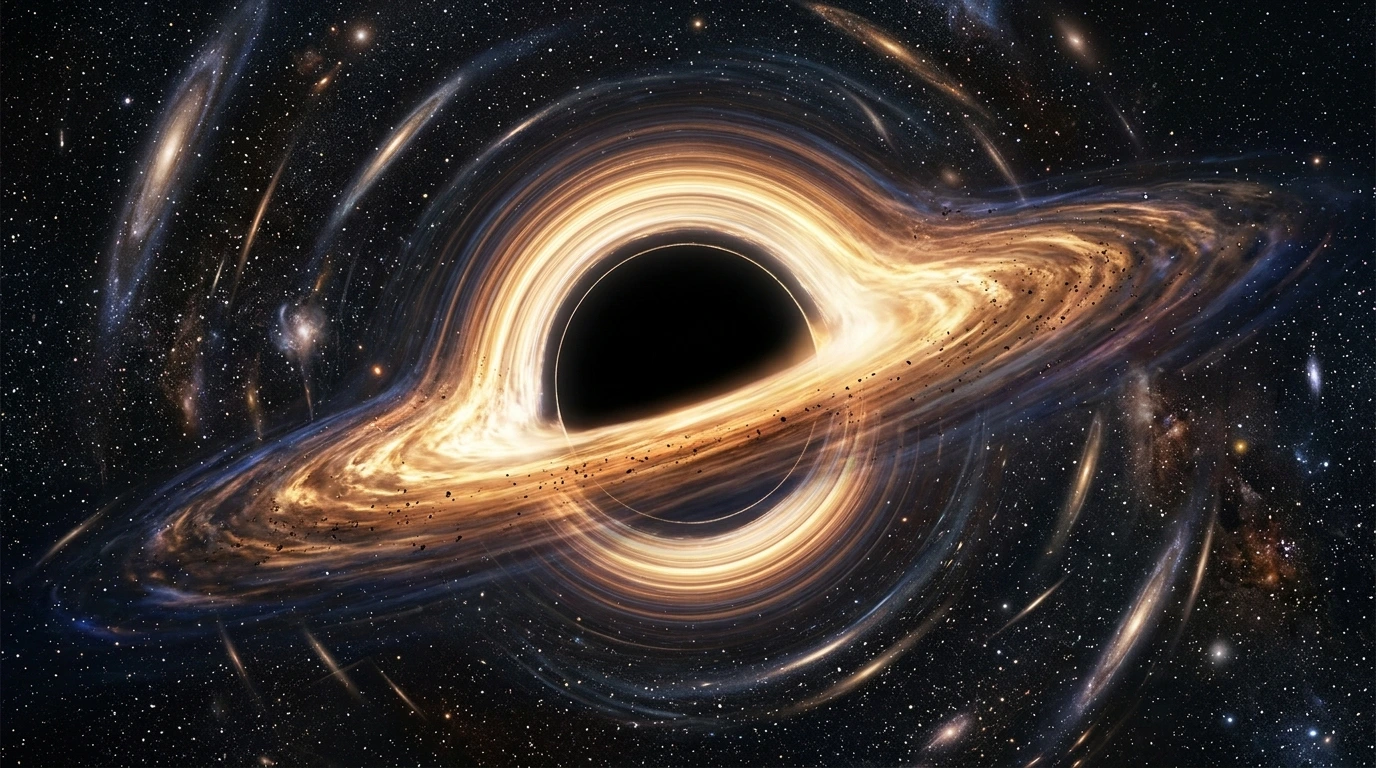
10 Fascinating Black Hole Facts and Misconceptions Explained
Black holes have a reputation for being cosmic monsters that swallow everything in sight, yet most of what we picture comes from sci-fi rather than actual physics. The truth is way weirder, from colliding giants that "chirp" across space to black holes that surprisingly help new stars form. Let's clear up the biggest myths and look at what's really happening out there.1. Black holes don't "suck" like vacuum cleaners.
What do people usually think?
Considering that a black hole has the strongest gravity in the universe, people often think that it can and will devour everything near it. But that’s not how they really work.
Here's the astonishing reality:
When discussing black holes, we shouldn't forget that distance matters too! This debunks the misconception that this abyss is like a "cosmic vacuum," which it is not.
While black holes' gravity is indeed the strongest in the universe, it does not indiscriminately pull everything nearby. Like any other massive object, it only affects things according to their distance. But if you are too close (like in the event horizon), escape becomes impossible.
2. The nearest known black hole is just 1,500 light-years away.
What do people usually think?
Since the closest black hole is only 1,500 light-years away, we usually believe it's a threat, and it might eventually destroy the Earth. Is this what we should be worried about?
Here's the astonishing reality:
Gaia BH1, the nearest known black hole to our planet, is not a threat and will not destroy our planet, according to the National Aeronautics and Space Administration (NASA).
The distance of this black hole is approximately 1,500 light-years away; it isn't near—it is incredibly, unimaginably far. And at its current distance, its gravity has absolutely no effect on Earth or our solar system.
Based on credible studies and research, it is an unlikely scenario for the Earth to be hit by any black hole, especially in the near future. They are not meteors or asteroids that could collide with Earth.
3. Not all black holes are massive.
What do people usually think?
A widely accepted misconception is that black holes are all enormous. As depicted in movies or science fiction, each black hole that ever existed is a universe-eating monster.
This may also be caused by confusion between mass and volume. Or perhaps, it's because they are known to have the strongest gravity in the universe.
Here's the astonishing reality:
There are actually four types of black holes.
A stellar mass, one of the smallest black holes, is formed when a large star completes its life cycle and collapses with a mass of up to 5 to 50 times that of our Sun. Then there are the so-called intermediate black holes.
They don’t get talked about as much, partly because they sit in an awkward middle zone, bigger than the stellar ones but still nowhere near the scale of the true giants. Those giants are the supermassive black holes. They are the ones holding millions, even billions, of solar masses in one place.
Finally, let's consider a more speculative concept: primordial black holes. They remain theoretical for now, since no one has spotted one yet.
4. Black holes can merge.
What do people usually think?
Many people assume black holes are completely isolated, solitary objects drifting alone in space. Because of this, the idea that two black holes could ever meet or, let alone, merge, sounds impossible or like pure science fiction.
Here's the astonishing reality:
Two black holes can indeed form a pair, and it has been observed multiple times through gravitational wave astronomy.
To put it simply, let’s explain it in layman’s terms!
When two black holes crash, they create ripples in space, like waves spreading across water. In a fleeting time, they release more power than every star in the universe shining at once.
These waves help scientists determine the size of the black holes and what happened when they collided. Notably, it is now more than just a theory.
The Laser Interferometer Gravitational-Wave Observatory (LIGO) detected gravitational waves from two merging black holes. Each black hole has approximately 30 times the mass of the Sun, and its signal has traveled over a billion light-years to reach us. It was important because it confirmed what Einstein had predicted back in 1916.
5. Einstein predicted black holes—but didn't believe they could exist.
What do people usually think?
Einstein predicted the existence of black holes during his time, without any doubt.
Hence, people assume he endorsed black holes as real objects, which he did not.
Here's the astonishing fact:
Einstein did not directly predict it mathematically. In fact, he was skeptical about their physical reality.
In 1916, Karl Schwarzschild discovered a solution to Einstein’s equations that essentially outlined what we call a black hole. The irony, however, is that Einstein himself remained unconvinced. In 1939, he even wrote a paper saying such objects couldn’t really form.
It took decades of further research and actual observations to confirm the existence of black holes.
6. A black hole collision sounds like a “chirp.”
What do people usually think?
People often think that the space is deafeningly silent, as if nothing can ever "make a sound" in its entirety.
Perhaps it's because when we imagine the universe, we don't have any idea what we should be hearing.
Here's the astonishing reality:
Astronomy often produces tons of stunning images of the universe, ultimately feeding our eyes.
With the Laser Interferometer Gravitational-wave Observatories (LIGO), we don't have to limit ourselves anymore to just seeing those images to imagine what it's like outside our planet.
We can now hear black holes spiraling into one another, as gravitational wave detectors convert their ripples in spacetime into audio signals.
The result might be a brief but distinct sound—a cosmic “chirp.”
Listen to it here.
7. Black holes may help create new stars.
What do people really think?
People usually think that black holes tend to destroy or suck everything in around them.
Maybe it's because they're too intimidating to even look at.
But in contrast to destroying everything, these black holes might actually help in creating something!
Here's the astonishing reality:
Under the right conditions, black holes can actually support the formation of new stars. This is supported by a new study that combines observation and cosmological simulations.
So, even when seen only as destructive, these supermassive black holes can actually help satellite galaxies keep their gas and continue forming new stars.
8. Some black holes may wander through space.
What do people usually think?
Black holes are often imagined as permanent fixtures at the heart of galaxies. While many do sit there, not all are so stationary.
Some of them drift, moving across interstellar space like cosmic nomads—and remarkably, a few are thought to be roaming right within the Milky Way.
Here's the astonishing reality:
Some of these cosmic heavyweights can actually go for a little drift through interstellar space… even right here in our own Milky Way! Although it was hard to catch these sneaky black holes, astronomers have discovered strong evidence confirming their peculiar motion.
9. Black holes may not destroy information.
What do people usually think?
For a long time, physicists thought that anything that fell into a black hole could never be recovered. What if I told you that black holes might not erase everything that falls into them?
Here's the astonishing reality:
Contrary to the belief that black holes erase all information, some scientists believe that it has been preserved, rather than totally lost. This puzzle is known as the black hole information paradox.
While Stephen Hawking originally suggested that information is lost, more recent studies propose that it isn't destroyed but may be preserved in some hidden way—possibly encoded in Hawking radiation or at the event horizon itself.
Physicist Dejan Stojkovic at the University at Buffalo has contributed research supporting the idea that black holes might not completely erase information after all.
10. Without black holes, we wouldn’t understand gravity as deeply as we do today.
What do people usually think?
Some individuals think Einstein's general relativity explains everything about gravity perfectly.
You won’t believe this, but black holes actually push the limits of Einstein’s theories!
Here's the astonishing truth:
Black holes are like the ultimate "stress test" for physics. They bend spacetime to such extremes that Einstein’s equations start to break down at the edges, where singularities lurk. That means black holes don’t just confirm relativity; they expose its limits.
Conclusion
Black holes prove that the real universe is far more surprising than anything Hollywood could ever come up with. Instead of just being mindless cosmic destroyers, they actually shape galaxies, push the limits of physics, and leave plenty of mysteries for us to keep unraveling. Every new discovery just shows how much more there is to learn about these incredible objects.If you enjoyed this or have another space myth you want us to break down next, drop a comment below!
Comments (0)
No comments yet. Be the first to comment!